
As per Rescind Machinery and Electrical Equipment Safety (Omnibus Technical Regulation) Order, 2024, the Order has been rescinded.
As per OTR Second Amendment Order, 2025, the Order would come into effect one year after its publication, i.e., automatically after 12 months. It means that the effective date of enforcement is no longer fixed.
The Omnibus Technical Regulation (OTR) is a key regulatory framework introduced by the Ministry of Heavy Industries (MHI), to ensure that industrial machinery, electrical equipment, assemblies, and related components manufactured or imported into India conform to uniform safety and performance standards. The regulation mandates compulsory BIS certification for notified products, making compliance essential for market access, installation, and sale within India.
OTR represents a shift from fragmented product-wise regulations to a consolidated, centralized quality compliance system, aligned with global manufacturing and safety practices.
1. Scope of OTR
The OTR applies to machinery and electrical equipment, including:
- Heavy industrial machines
- Automation and production equipment
- Power distribution equipment and control panels
- Valves, gear assemblies, power transmission components
- Sub-assemblies and replaceable parts, where specified
Coverage under OTR is continuously expanding, and manufacturers must routinely check BIS notifications to determine applicability.
2. Certification Paths Under OTR
OTR implementation happens through BIS Scheme-X, the certification mechanism designed specifically for machinery and electrical equipment.
Under Scheme-X, manufacturers can obtain either:
- BIS Licence → For continuous production (Standard Mark)
- Certificate of Conformity (CoC) → For a specific consignment or project supply
Both domestic and foreign manufacturers are eligible, but foreign manufacturers must appoint an Indian Authorized Representative (AIR).
3. Indian Standards Under OTR
Products under OTR order must conform to the following Indian & Harmonized Safety Standards:
- Type A Standard: IS 16819:2018 / ISO 12100:2010 – Safety of Machinery: Risk assessment and risk reduction.
- Type B Standards: As listed under the Second Schedule of the OTR Order (generic safety standards applicable across machinery categories).
- Type C Standards: As listed under the Third Schedule (product-specific safety and performance standards).
In essence, OTR certification ensures that the design, materials, operation, and manufacturing processes of machinery are fully aligned with recognized Indian and international safety frameworks, safeguarding both users and industry stakeholders.
4. Documents Required for OTR Registration
Manufacturers must provide the following information for registration:
- Application Form (BIS Scheme-X): Formal application submitted to BIS requesting Grant of License or Certificate of Conformity (CoC).
- Technical File / Technical Dossier: Includes evidence of compliance with Type A, Type B, and Type C Standards, complete design documentation, safety features, protective measures, and conformity assessment details.
- Test Reports: Product testing results demonstrating compliance with relevant Indian Standards, preferably from BIS-recognized laboratories.
- Risk Assessment Sheet: Evaluation of potential hazards, safety functions, risk control measures, and mitigation strategies followed during the manufacturing and operational lifecycle.
- Compliance Checklists: Machine-specific compliance checklists as prescribed by BIS (e.g., milling machines, presses, EDM machines, turning machines, forming machines, etc.).
- Model Declaration: Declaration specifying machine models, families of models, variants, and identification of the lead model representative for testing and evaluation.
- Labeling & Marking Plan: Proof of conformity to BIS Standard Marking guidelines including rating plates, safety labels, equipment markings, usage instructions, and compliance markings format.
- Factory Documents: Records demonstrating quality management systems, production process controls, maintenance practices, calibration systems, and evidence of continuous conformity in manufacturing.
5. OTR Certification Process
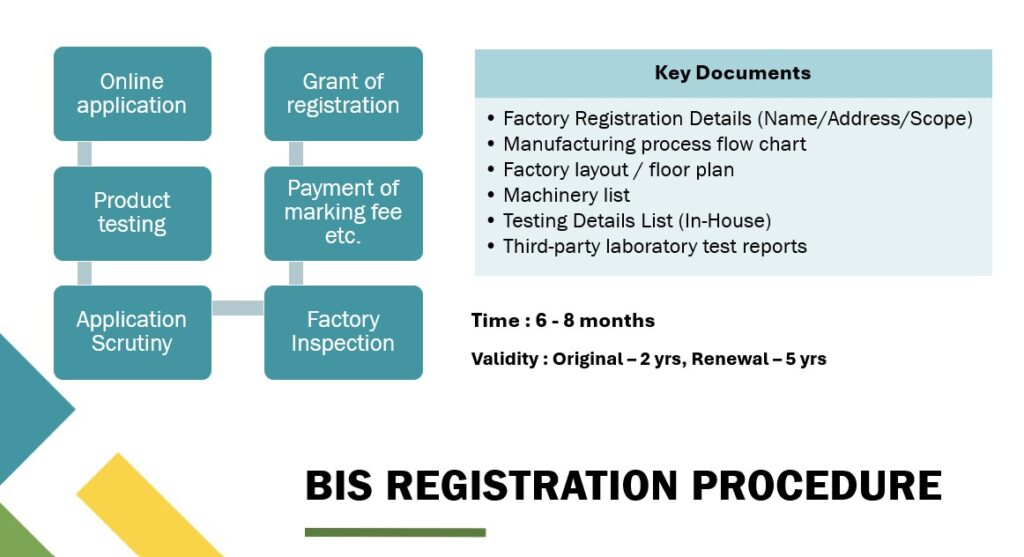
The process begins by determining, which IS applies to the product, followed by preparation of documentation, testing of product samples, and a factory audit to verify manufacturing quality controls.
The steps below summarize the standard certification workflow under OTR:
| Step | Stage / Action | Description |
|---|---|---|
| 1 | Identify Applicable IS Standard | Evaluate the product’s design, function, and specifications to determine the correct Indian Standard under which the product must comply. |
| 2 | Determine Certification Type (Licence or CoC) | Decide whether the product requires a continuous BIS Licence (for ongoing production) or a Certificate of Conformity (for project/lot imports). |
| 3 | Prepare Technical & Quality Documentation | Compile documentation including product drawings, Bill of Materials (BOM), QC procedures, calibration records, material traceability, and safety design files. |
| 4 | Submit Application to BIS | File the application with BIS along with factory details, product specifications, documents, and applicable fees. |
| 5 | Factory Audit by BIS | BIS auditors inspect production processes, quality testing capability, raw material controls, and record-keeping systems to verify compliance. |
| 6 | Product Sample Testing | Samples are selected and tested in a BIS-recognized laboratory to confirm compliance with performance, safety, and reliability requirements of the Indian Standard. |
| 7 | Corrective Actions (If required) | If deviations or non-conformities are identified, the manufacturer implements corrective measures or undergoes re-testing to achieve conformity. |
| 8 | Grant of Licence / CoC | Upon successful completion of documentation review, audit, and testing, BIS issues the BIS Licence (for Standard Mark use) or CoC (for one-time shipment certification). |
| 9 | Marking & Post-Certification Compliance | ISI marking guidelines are enforced; manufacturer maintains ongoing QC controls and undergoes periodic surveillance audits as mandated. |
Note that documentation correctness and audit readiness significantly influence certification speed. Incorrect IS selection is the most common cause of delays and rework, hence the first step is critically important.
6. OTR Certification Cost and Timeline
To simplify the certification process, manufacturers must adhere to the specified fee structure.
Note that BIS gives concessions to the below fees for MSME, Start-ups, women entrepreneur enterprises and north-eastern areas.
| No. | Fee Type | Fee (in ₹) |
|---|---|---|
| 1 | Application fee for grant of licence | ₹2,000 |
| 2 | Application fee for grant of certificate of conformity | ₹2,000 |
| 3 | Certification fee for grant or renewal of licence | ₹25,000 per year |
| 4 | Certification fee for grant of certificate of conformity (CoC) | ₹10,000 |
| 5 | Fee for review of technical file for licence / CoC / change in scope | ₹20,000 per technical file |
| 6 | Inspection / Surveillance visit charges | On actuals |
| 7 | Sample procurement charges | On actuals |
| 8 | Testing charges | On actuals (as per BIS-recognized lab) |
| 9 | Refundable bank guarantee | 10,000 USD (Foreign manufacturers) |
For a foreign manufacturer, the cost can reach up to 20,000 USD to 25,000 USD.
The actual time taken on whole certification process depends on the documentation quality and precision. Still. in general, OTR applications take:
- 3-6 Months for domestic manufacturers
- 6-9 Months for foreign manufacturers
7. Products Covered under OTR
| Sr No. | Description of Machinery and Electrical Equipment | HS Code |
|---|---|---|
| 1 | All types of Pumps for handling liquids, liquid elevators and (or) their assemblies /sub-assemblies/components | 841340, 841350, 841360, 841370, 841381, 841382 841391 and 841392. |
| 2 | All types of compressors and (or) their assemblies /sub-assemblies/components | 841430, 841440, 84148011, 84148090, 84149011,84149019, 84149040 and 84149090. |
| 3 | All types of machinery for treatment of material by a process involving a change of temperature and/or their assemblies /sub-assemblies/components | 841932, 841939,841940, 841950, 841960,841981, 841989 and 84199090. |
| 4 | All types of centrifuges, filtering or purifying machinery for liquid and gas and/or their assemblies /sub-assemblies/components | 842111, 842112, 842119, 84212110, 84212190, 842122, 842129, 842131, 842139, 842191 and 842199. |
| 5 | All types of machinery for filling, closing, sealing, labeling bottles, packing or wrapping and/or their assemblies /sub-assemblies/components | 842220, 842230, 842240 and 842290. |
| 6 | All types of cranes and (or) their assemblies /sub-assemblies/components | 842611, 842612,842619, 842620, 842630,842641, 842649, 842691 and 84269990. |
| 7 | All types of machinery for construction, earthmoving, Mining and (or) their assemblies /subassemblies/components | 8429, 843010, 843020, 843031, 843039, 843041, 843049, 843050, 843141, 843142, 843143 and 843149. |
| 8 | All types of weaving machines (looms) and (or) their assemblies /sub-assemblies /components. | 8446, 844811, 844819, 844842 and 844849. |
| 9 | All types of machinery for making embroidery and (or) their assemblies /sub-assemblies /components. | 84479020 and 844859. |
| 10 | All types of metal cutting machines tools covered under the heading 8456 to 8461 and (or) their assemblies /sub-assemblies/components | 8456, 8457, 8458, 8459, 8460, 8461 and 846693. |
| 11 | All types of machine tools for working stone, ceramics, concrete, asbestos cement or like mineral (or) and their assemblies /subassemblies /components. | 8464 and 84669100. |
| 12 | All types of machinery for working rubber and plastics and (or) their assemblies /sub-assemblies /components | 8477. |
| 13 | All types of Machines including the machines for public works & building and the machinery & mechanical appliances having individual functions, not specified Or included elsewhere in Chapter 84 and(or) their assemblies/subassemblies /components | 84791000, 84798999 and 84799090. |
| 14 | All types of gears and gearing, toothed wheels, chain sprocket, transmission elements ball or roller screws, gear boxes and speed changers, including torque converters And (or) their assemblies /sub-assemblies /components | 84834000 and 84839000. |
| 15 | All types of Rotary electrical machines such as Generator, etc and (or) their assemblies /sub-assemblies /components. | 8501 and 8503. |
| 16 | All types of Diesel Generator and (or) their assemblies /sub-assemblies /components. | 8502 and 8503. |
| 17 | All types of Transformers and (or) their assemblies /sub-assemblies /components. | 850421, 850422,850423, 850431, 850432,850433, 850434 and 850490. |
| 18 | All types of Power Semiconductor Converter and (or) their assemblies /sub-assemblies /components. | 850440. |
| 19 | All types of switch gear and control gear equipment operating at voltages not exceeding 1000 volts and (or) their assemblies /sub-assemblies /components. | 8536, 8537 and 8538. |
| 20 | All types of switch gear and control gear equipment operating at voltages exceeding 1000 volts and (or) their assemblies /sub-assemblies /components. | 8535, 8537 and 8538. |