
The BIS Scheme-X was introduced to regulate the safety of industrial machinery and electrical equipment through testing and technical conformity assessment. However, following the revocation of the Omnibus Technical Regulation, the scope of Scheme-X has been reduced and currently applies mainly to Low Voltage Switchgear and Controlgear products.
1. Products Under Scheme-X
The Scheme-X generally contains only the following types of the products:
- Low – Voltage switchgear and controlgear
Some of the products in these lists are:
| S. No. | Products |
|---|---|
| 1 | AC Circuit – Breakers |
| 2 | All AC utilization categories, All DC utilization categories |
| 3 | Contactor – All AC utilization categories, Starter – All AC utilization categories |
| 4 | Semiconductor Motor Controllers and Starters and Soft Starters |
| 5 | Control Circuit Devices and Switching, All devices with button type actuator, All devices with all types of actuator |
| 6 | |
| 7 | |
| 8 | |
| 9 | |
| 10 | |
| 11 | |
| 12 | |
| 13 | |
| 14 | |
| 15 | |
| 16 | |
| 17 | and so on… |
These are categories / examples – not a definitive exhaustive list issued by BIS. You can review the complete list of products on BIS website.
For each product you should verify the corresponding IS standard, HS code, sub-assembly coverage, etc.
2. Documents Required
The application for obtaining a BIS License / Certificate of Conformity (CoC) under Scheme-X must be submitted along with the following documents:
A. General Application Documents
| Sl. No. | Document | Description / Purpose |
|---|---|---|
| 1 | Factory Address Proof | Any Government-issued document showing the complete manufacturing address. |
| 2 | Authorization Letter (if applicable) | Required if the application is signed by someone other than the CEO / Head of Organization. |
| 3 | Manufacturing Process Flow Chart | Step-by-step diagram describing the production process. |
| 4 | List of Manufacturing Machinery | Details of machinery installed in the production facility. |
| 5 | Details of Outsourced Manufacturing (if any) | Disclosure of any outsourced operations in the production line. |
| 6 | Outsourcing Agreement (if applicable) | Valid agreement supporting outsourced manufacturing arrangements. |
| 7 | List of Testing Equipment | Complete list of in-house testing instruments with specification. |
| 8 | External Testing Arrangement Details (if applicable) | Information on BIS-recognized external testing facility being used. |
| 9 | Calibration Certificates | Valid calibration certificates for all testing equipment. |
| 10 | Technical File | Comprehensive dossier containing product and compliance details (explained below). |
B. Contents of the Technical File
| Sl. No. | Document | Description / Required Details |
|---|---|---|
| 1 | Product Description | Product type, model, variant, size, grade, etc. |
| 2 | Applicable Standard(s) | Indian Standards and safety requirements the product must meet. |
| 3 | Product Photographs | Clear images for product verification and identification. |
| 4 | Manufacturer Details | Name, address, and factory contact details. |
| 5 | Product Identification / Marking Details | Brand name, trade mark, batch/lot/serial no., date of manufacture, etc. (CoC applications must include quantity & batch details.) |
| 6 | Product Design Documentation | Schematics, drawings, and design elements required to demonstrate safety compliance. |
| 7 | Manufacturing Process Description | Key steps and internal quality checkpoints. |
| 8 | Product Compliance Report | Risk assessment, safety function diagrams, validation reports, and reference test reports from: BIS certificate / OEM datasheet / BIS-recognized lab / in-house lab / accredited lab. |
| 9 | In-House Quality Assurance (IQA) Plan | Inspection plan, test plan, and system for continuous quality control. |
| 10 | User / Installation / Maintenance Instructions | Final user manual including safe installation and operating procedures. |
| 11 | Other Product-Specific Requirements | Any additional documents mandated by BIS for the particular product. |
BIS has notified an extensive checklist to help with the documentation preparation.
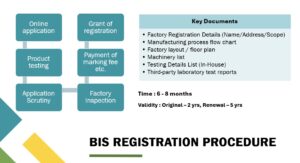
3. Scheme-X Certification Process
There may be a few differences between two applications based on the product, manufacturing location, etc. but overall, these below listed steps remain same:
| Step | What Happens Here |
|---|---|
| 1. Application Submission | Application is made in Form-I as per Scheme-X of BIS Conformity Assessment Regulations, 2018. Documents and fees must be submitted. |
| 2. Technical File Preparation | Manufacturer prepares a Technical File covering the document discussed above |
| 3. Test Report & Sample Requirements | The product compliance report must include test reports either from third-party BIS-recognized labs or manufacturer’s in-house lab (with witness testing). If third-party labs are used, applicant must register on BIS portal, get unique code, submit sample with code, upload receipt. Test reports should generally not be older than one year; type tests may be accepted up to five years old. For long-duration tests (30 days+), undertakings or witness test arrangements may be required. |
| 4. Factory / On-site Audit / Inspection Visit | BIS conducts an inspection visit to the manufacturing facility to verify manufacturing infrastructure, production process, quality assurance systems including testing infrastructure and traceability. Normally two days for Indian manufacturers and three days for foreign manufacturers; extra man-days if multiple technical files. Witness testing may be required for in-house labs or subcontracted test facilities. |
| 5. Review & Decision of Licence Grant | After verification of documentation, test reports and inspection results, BIS processes the application. Target is within 60 days of application receipt (for complete cases). For first-time product certifications, up to 90 days may be allowed. Licence is granted initially for not less than 3 years and up to 6 years. |
| 6. Surveillance & Post-Licence Compliance | Once licence is granted, BIS retains right to carry out surveillance audits at any time to verify continued compliance. Applicants/licensees must maintain product conformity, permit audits, and comply with marking and quality requirements. |
4. Cost and Fees
| Sl. No. | Fee Type | Fee (₹) | Additional Notes – Foreign Manufacturers |
|---|---|---|---|
| 1 | Application fee for grant of Licence | 2,000 | Same for all applicants; no scale-based concession applies. |
| 2 | Application fee for grant of Certificate of Conformity (CoC) | 2,000 | Applicable when a batch or consignment supply is certified. |
| 3 | Certification fee for grant / renewal of Licence | 25,000 per year | Valid for Indian and foreign manufacturers alike; renewal payable annually. |
| 4 | Certification fee for grant of Certificate of Conformity (CoC) | 10,000 | One-time fee for batch certification under CoC route. |
| 5 | Fee for review of Technical File (for Licence / CoC / change in scope) | 20,000 per technical file | Applies when new model is added or scope expanded. |
| 6 | Inspection / Surveillance Visit Fees | 20,000 per man-day | For foreign manufacturers: all travel, logistic and stay costs of BIS inspectors must be borne in addition. |
| 7 | Sample Procurement Charges | On actuals | Foreign manufacturers bear full costs of sample transportation, customs, etc. |
| 8 | Testing Charges | On actuals | Foreign manufacturers must pay full laboratory testing fees and shipping costs. |
Important Notes for Foreign Manufacturers
- Additional performance bank guarantee of 10,000 USD per application.
- Factory visit changes between 6,000 USD to 10,000 USD based on the country of manufacturer.
- Manufacturers outside the territory of India shall bear all expenses, including days spent by BIS certification officers (from departure to return), travel, accommodation, and test-costs.
- Concessions (discounts) are available only for Indian manufacturers based on scale (MSME/start-up) and do not apply to foreign manufacturer expenses.
- All fees are subject to standard amendments by BIS; actual scope/model may have additional fees if notified separately.
5. Certification Time (End-to-End)
- Indian Manufacturers: 10–14 Weeks
- Foreign Manufacturers: 24-36 weeks
Time varies based on:
- Readiness of documentation
- Machine complexity and number of models
- Lab availability and testing duration
- Speed of response to BIS queries
6. How We Assist as BIS Consultants
As a BIS compliance partner, we provide end-to-end support, including:
- Identifying correct Indian Standards
- Preparing the technical file & risk assessment
- Drafting checklists, model declaration & label plan
- Coordinating with BIS during application & review
- Managing factory audit readiness
- Handling testing and sample selection
- Ensuring smooth grant of Licence / CoC
Our approach reduces delays, objections, re-testing, and unnecessary costs.