
The FMCS is the BIS scheme designed to allow foreign manufacturing units to certify their products for the Indian market. The FMCS scheme enables overseas companies to obtain the BIS Standard Mark (ISI mark) and legally import and sell products in India under mandatory or voluntary certification requirements.
Unlike CRS Registration (which is document-based and does not involve site inspection), FMCS requires a factory audit by BIS officials, making the process more detailed and compliance-heavy. Therefore, planning and documentation accuracy become very important.
1. What Products Are Covered under FMCS?
Common product categories under FMCS include:
- Cement & Construction Materials
- Steel and Alloy Products
- Electrical Appliances (Geysers, Motors, etc.)
- Automotive products
- Valves, Pumps & Industrial Machinery Components
- and so on…
If your product appears in any of the notified QCO, FMCS licensing becomes compulsory, not optional. To determine whether your product requires FMCS certification, a product applicability evaluation is recommended before proceeding.
2. FMCS Certification Process
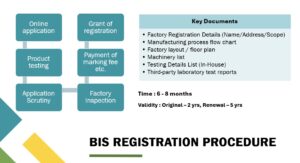
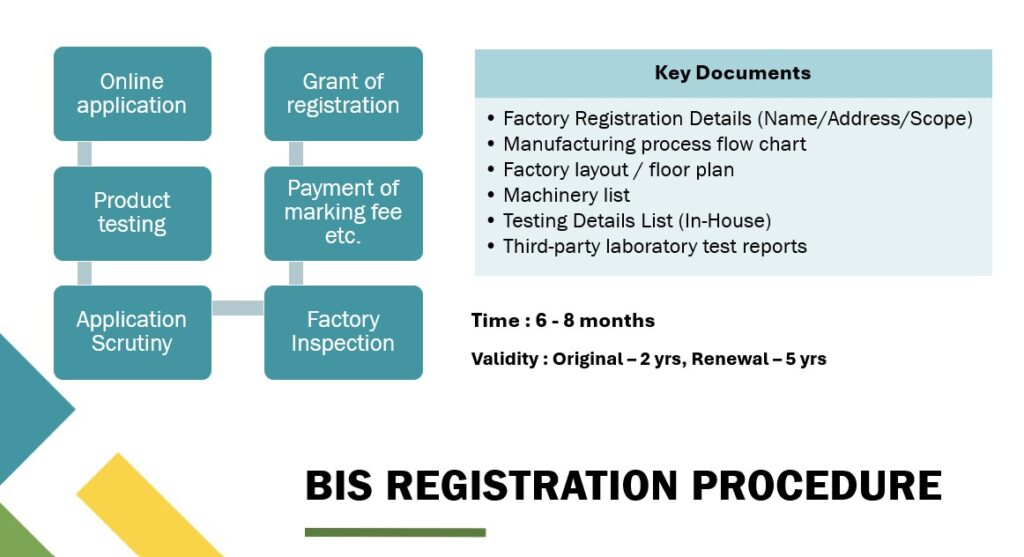
While timelines depend on product type and factory readiness, the FMCS certification generally follows these stages:
| Step | Description |
|---|---|
| 1. Identify Applicable Standard (IS Code) | The product specifications are reviewed to determine which Indian Standard applies and whether FMCS is mandatory. |
| 2. Appointment of Indian Authorized Representative (AIR) | The foreign manufacturer designates an Indian representative who will act as the legal and communication liaison with BIS. |
| 3. Preparation of Documentation | Factory licenses, process flowcharts, test equipment details, QC manuals, labeling details, and technical documents are compiled and formatted as per BIS requirements. |
| 4. Product Testing in BIS Recognized Laboratory | Sample units are sent to a BIS-approved testing lab in India, where the product is tested according to the Indian Standard parameters. |
| 5. Submission of Application to BIS | The complete FMCS application, along with test reports and supporting documents, is filed with BIS for technical review. |
| 6. Factory Audit by BIS Officials | BIS officers physically visit the manufacturing facility to verify production capability, QC systems, test setups, traceability, and batch controls. |
| 7. Clarifications and Corrective Actions | Any observations from testing or inspection are addressed; additional documents or process improvements are submitted if required. |
| 8. Grant of ISI License | After successful verification, BIS issues the FMCS License along with permission to use the ISI Mark on the product. |
| 9. Marking & Ongoing Compliance | The manufacturer affixes the ISI Mark with the license number and complies with ongoing surveillance audits and product testing. |
3. Indian Authorized Representative (AIR)
Foreign manufacturers must appoint an Indian Authorized Representative (AIR). The AIR serves as the official point of contact between the manufacturer and BIS and assumes regulatory accountability within India.
- Ideally, each foreign manufacturer must have a branch office in India that will handle all of its duties and obligations with regard to the BIS Act as well as any rules and regulations formulated for the purpose of registration.
- In the event that manufacturer does not have a branch office in India, it must designate a local representative in charge of filing and overseeing the certification application and is accessible to respond to inquiries.
The applicant must be sure of the following when nominating the AIR:
- The foreign manufacturer’s nominee for AIR must be an Indian citizen.
- In connection with the grant and operation of the license, AIR shall agree that he is responsible for adhering to the terms and conditions stated in the BIS license, agreement, undertaking, and any other documents executed on behalf of the foreign manufacturer.
- AIR is only able to represent one foreign manufacturer at a time; it is not permitted to act in the place of other foreign applicants.
- When AIRs examine a sample in a third-party laboratory, they will not have a conflict of interest in their capacity as AIRs.
- The minimum qualification for an AIR is a bachelor’s degree and knowledge of the provisions of the BIS Act, 2016, as well as rules and regulations.
- AIR’s name shall appear in the license documents.
This requirement is mandatory and cannot be bypassed.
4. Certification Timeline
The duration for obtaining a BIS FMCS License varies depending on product complexity, laboratory testing schedules, and factory readiness. However, the process generally progresses through defined stages:
| Stage | Typical Duration |
|---|---|
| Application Preparation & Submission | 1–2 Weeks |
| Product Testing (BIS Recognized Laboratory) | 2–6 Weeks |
| Factory Inspection by BIS Officials | 4–8 Weeks (dependent on audit scheduling & travel arrangements) |
| Final Review & Grant of License | 2–4 Weeks |
Estimated Total Certification Time: On average, it takes six to nine months from the date of receipt of the completed application and its documentation to grant a license. It may also vary for other reasons, such as the applicant’s delay in responding to inquiries, sample transportation, fee payments, etc.
5. Certification Cost
Managing BIS FMCS certification involves several cost components, and understanding the financial aspects upfront helps manufacturers plan efficiently and avoid surprises during execution. The overall cost varies based on the product category, testing requirements, factory location, and the extent of compliance readiness.
Below is a clear breakdown of the typical cost elements involved in obtaining an FMCS (ISI Mark) license, along with realistic cost ranges based on current BIS fee structures and industry practice.
| Cost Component | Cost Range (Approx.) | Notes |
|---|---|---|
| BIS Application Fee | $30 (tentative) | Fixed government fee for application submission. |
| BIS Marking fee | $500 to $750 (tentative) | On actuals |
| Factory audit fee | $5000 to $5500 (tentative) | On actuals |
| Annual License fee | $30 (tentative) | Fixed government fee |
| Performance Bank Guarantee | $10,000 | Till the certificate is not surrendered |
| Product Testing Charges | As per Lab charges | Depends on product category, number of tests, and testing lab. Some industrial items can cost higher. |
| Travelling & accommodation expenses of BIS officials for factory visits including one professional | As per actual expenses | Varies significantly depending on country and distance from India. Manufacturers must reimburse actual costs. |
| Consultancy / Process Management Fees (Optional) | ₹2,50,000 – ₹5,00,000 per license | Covers documentation, testing coordination, audit guidance, communication handling & application management. |
For a precise quote, please contact us for a free estimate.
6. Mandatory Documents for FMCS Certification
The following list of non-exhaustive list of documents, generally required in FMCS applications:
- Business license and ISO certificate (English translation is mandatory, if license/certificate is available in any other language).
- Process flow chart.
- Certificates for products or factory systems (if any).
- List of manufacturing machinery.
- List of raw materials and raw material test certificate.
- Test Equipment Calibration Certificate.
- Drawing of the product or its components.
- Test report according to Indian Standards.
- Authorized Indian Representative (AIR) details
- Undertaking and Declaration.
7. Validity and Renewal of Certificate
Initially, the license is provided for a minimum of one year and a maximum of two years. Depending on whether the yearly license fee and advance minimum marking charge have been paid, the license renewal may be considered for a minimum of one year and a maximum of five years.
An INR 5,000 (US$60.03) late charge must be included with the renewal application if it is submitted after the license has expired.
The following must be included in a renewal request:
- A renewal application (Form XII)
- Production details, broken down by month and consignee address in full
- Extended Performance Bank Guarantee: six months beyond the license’s expiration date
- Payment of the relevant marking costs
8. Products List and Quality Control Orders
As prescribed by the BIS, there are over 200 items that are mandated to obtain a quality certificate. The articles are product-wise categorized in the following table. Please note that BIS keep adding new products time-to-time using new QCOs and amendment orders.
| No. | Product / Item | Quality Control Order |
|---|---|---|
| 1. | Cement | Cement (Quality Control) Order, 2003 |
| 2. | Household Electrical goods | Electrical Wires, Cables, Appliances and Protection Devices and Accessories (Quality Control) Order, 2003 |
| 3. | Batteries | Multipurpose Dry Batteries (Quality Control) Order, 1987 |
| 4. | Food & Related Products | Food Safety & Standards Prohibition & Restriction on Sales, Regulation, 2011Solvent Extracted Oil, De-oiled Meals and Edible Flour (Control) Order, 1967The Infant Milk Substitutes, Feeding Bottles and Infant Foods (regulation of production, supply and distribution), Act 1992 |
| 5. | Oil Pressure Stoves | Oil Pressure Stoves (Q.C) Order, 1997 |
| 6. | Automobile Accessories | Pneumatic Tyres and Tubes for Automotive Vehicles (Quality Control) Order, 2009 |
| 7. | Cylinder, Valves and Regulation | Explosive Act, 1884Gas Cylinder Rules, 2016 |
| 8. | Medical Equipment | Clinical Thermometers (Quality Control), 2001Diagnostic Medical X- Ray Equipment |
| 9. | Steel Products | Steel and Steel Products (Quality Control) Order, 2020Ductile Iron Pressure Pipes and Fittings (Quality Control) Order, 2009 Mild Steel Tubes (excluding seamless tube & tubes according to API Specification) (Quality Control) order,1978 and Amendment Order, 1983 |
| 10. | Electrical Transformers | Electrical transformers (Quality Control ) order, 2015 |
| 11. | Electrical Motors | Energy Efficient Induction Motor (Quality Control) Order, 2017 |
| 12. | Capacitors | Electrical Capacity (Quality Control) Order, 2017 |
| 13. | Chemicals and Fertilizers | Bureau of Indian Standard (Caustic Soda) Order, 2018Bureau of Indian Standards (Standards for Boric Acid) Order, 2019Poly Aluminium Chloride (Quality Control) Order, 2019Acetic Acid (Quality Control) Order, 2019Aniline (Quality Control) Order, 2019Amendment in Methanol (Quality Control) Order, 2019 |
| 14. | Kitchen Appliances | Bureau of Indian Standards Kitchen Appliances (Quality Control) Order, 2018 |
| 15. | Domestic Water Heaters for use with LPG | Bureau of Indian Standards Domestic Water Heater for Use with Liquefied Petroleum Gas (Quality Control) Order, 2018 |
| 16. | Air Conditioner and its related Parts, Hermetic Compressor and Temperature Sensing Controls | Air Conditioner and its related Parts, Hermetic Compressor and Temperature Sensing Controls (Quality Control) Order, 2019 |
| 17. | Plugs and Socket-Outlets and Alternating Current Direct Connected Static Prepayment Meters for Active Energy | Plugs and Socket-Outlets and Alternating Current Direct Connected Static Prepayment Meters for Active Energy (Quality Control) Order, 2019 |
| 18. | Domestic Gas Stoves for use with Liquefied Petroleum Gases | Domestic Gas Stoves for use with Liquefied Petroleum Gases (Quality Control) Order, 2019 |
| 19. | Transparent Float Glass | (Quality Control) Order, 2019 S.O. 03 (E) dated 31/12/2019 |
| 20. | Domestic Pressure Cooker | (Quality Control) Order, 2020 S.O. 294 (E) dated 21/01/2020 |
| 21. | Cables | Cables (Quality Control) Order, 2020 S.O. 294 (E) dated 21/01/2020 |
| 22. | Rubber Hose for Liquefied Petroleum Gas (LPG) | Rubber Hose for Liquefied Petroleum Gas (LPG) (Quality Control ) Order, 2020 S.O. 478(E) dated 28th January 2020 |
| 23. | Aluminum Foil | Aluminium Foil (Quality Control) Order, 2020 S.O. 687 (E) dated 13/02/2020 |
| 24. | Toys | Toys (Quality Control ) Order, 2020 S.O. 853(E) dated 25th February 2020 |
| 25. | Flat Transparent Sheet Glass | Flat Transparent Sheet Glass (Quality Control ) Order, 2020 S.O. 738(E) dated 14th February 2020 |
| 26. | Safety Glass | Safety Glass (Quality Control ) Order, 2020 S.O. 1045(E), dated 12th March 2020 |
9. We Can Help
As a BIS compliance partner, we provide end-to-end advisory, documentation, and execution support, ensuring that your certification process is completed efficiently, accurately, and without avoidable delays.
- Product Applicability Assessment: We verify whether the product falls under mandatory ISI certification and identify the correct Indian Standard.
- Documentation Preparation: We prepare, format, and align all required factory, QC, calibration, and technical documents as per BIS guidelines.
- Indian Authorized Representative (AIR) Support: We assist in appointing a compliant AIR and handling legal and procedural formalities.
- Testing Coordination: We manage product sample selection, dispatch, and testing at BIS-recognized laboratories in India.
- Audit Readiness & Training: We prepare the factory team for BIS inspection, including quality process validation, record management, and internal compliance checks.
- BIS Communication & Query Handling: We respond to BIS technical queries, clarifications, and compliance requests on behalf of the manufacturer.
- License Grant & Marking Guidance: We ensure correct ISI marking, labeling, and batch traceability formats post certification.
- Post-License Compliance Support: We assist in renewals, surveillance audits, and ongoing quality conformity requirements.
FAQs
FMCS (Foreign Manufacturers Certification Scheme) is a certification scheme under BIS through which manufacturers located outside India can obtain the ISI Mark license to sell their products in India. It ensures that the product complies with the relevant Indian Standard (IS) before entering the Indian market.
Any foreign manufacturer whose product is covered under mandatory BIS certification (as per BIS Act/QCO notifications) and who wants to export or sell in India must obtain FMCS certification.
Yes. If the product appears in the BIS mandatory list / Quality Control Orders, then FMCS license is compulsory to sell the product in India. Without it, import and sale are legally prohibited.
Yes, the manufacturer applies, but they must appoint an Authorized Indian Representative (AIR) in India to liaison with BIS, receive communications and take responsibility for compliance.
AIR is a person/entity in India nominated by the foreign manufacturer.
Responsibilities include:
- Coordinating with BIS
- Signing application and compliance documents
- Handling surveillance & market issues
AIR must be legally liable in India on behalf of the manufacturer.
Products like electrical appliances, wires, cement, chemicals, steel products, valves, bearings, food packaging metal containers, and many others listed under Product Certification Scheme (Scheme-I) and notified QCOs.
(Exact product list is available on BIS website.)
- Identify Applicable Indian Standard (IS)
- Prepare factory documents & quality testing setup
- Appoint AIR
- Submit online application on BIS portal
- Pay fees & submit product samples
- Product testing in BIS-recognized laboratory
- BIS officer factory inspection (onsite)
- Review & license grant
- Marking fee payment & ISI mark use
- Manufacturing company registration
- Production flow chart
- Quality control process documents
- Testing equipment list & calibration records
- Factory layout
- Product standards test report
- AIR authorization documents
- Legal agreements / Undertakings required by BIS
Yes. Product must be tested only in BIS-recognized laboratories according to the relevant Indian Standard. Test reports from non-BIS labs or international labs are not accepted.
Fees generally include:
- Application fee
- Laboratory testing charges
- BIS officer inspection & travel charges
- Annual licence fee
- Marking (ISI logo) fee
Exact fee varies by product and factory size.
Typically, 6 to 9 months after complete application, depending on factory readiness, documentation quality, and testing timelines.
Generally, 2 years, renewable further as long as the manufacturer continues to comply with BIS standards and pays marking & renewal fees.
Yes. If the new model complies with the same Indian Standard, additional product models can be added after testing & approval.
No. International certifications are not accepted as substitutes. If a product is mandated under BIS, FMCS license is compulsory for India.
The manufacturer can use the ISI Mark along with the Licence Number (CM/L Number) on each product and packaging.
The manufacturer must upgrade manufacturing and testing to meet the revised standard and re-submit compliance to BIS within the specified timeline.
Yes. BIS officials visit the foreign manufacturing site to verify:
- Production capability
- Quality management system
- Testing equipment availability
- Consistency & traceability of product
This is mandatory before license is granted.
Yes. BIS periodically:
- Reviews marking fee and quantity report submissions
- Conducts surprise factory inspections
- Takes market samples for testing
Selling or importing products without BIS approval (if required) may result in:
- Legal prosecution
- Confiscation of goods
- Import clearance rejection
- Financial penalties
You can verify any license on the BIS public database: 🔗 https://www.manakonline.in (BIS License Search)