
The Compulsory Registration Scheme (CRS) is a certification program introduced by the Bureau of Indian Standards (BIS) under the Ministry of Electronics and Information Technology (MeitY). The CRS scheme ensures that electronic and IT products sold in India meet minimum safety and quality requirements before being placed in the market.

1. What is the BIS CRS (Compulsory Registration Scheme)?
Under CRS, manufacturers must get their products tested and registered with BIS. Only after receiving the BIS Registration Number, the manufacturer is allowed to mark the product with the BIS CRS Logo and legally sell or distribute it across India. Unlike traditional certification schemes that rely on extensive factory inspections, CRS operates on a self-declaration model, making it both rigorous and relatively streamlined.
CRS aimed to reduce the presence of substandard electronic and IT goods in the Indian market. Initially covering 15 product categories, it has since expanded to over 76+, including smartwatches, laptops, LED lights, printers, CCTV cameras, solar PV modules, and safes. The government lists these items in separate Quality Control Orders (QCOs).
CRS certificate ensures that electronic products:
- Are safe for everyday use
- Are free from electrical hazards
- Meet Indian quality performance standards
- Are not harmful to life or property
2. Who Needs BIS CRS Registration?
CRS applies to manufacturers, not traders. It is required for:
- Indian Manufacturers
- Foreign Manufacturers exporting to India
- OEM / Private Label Manufacturers
If you sell your product under your brand, the brand owner must also be listed on the BIS license.
3. Products Covered Under BIS CRS
More than 70+ electronic and IT products are listed under the CRS category, including:
- Smartphones, Tablets, Laptops & Smart TVs
- LED Lights & Drivers, Power Inverters, Power Banks
- Bluetooth Speakers, Smart Watches, Home Assistants
- Wireless Earphones, CCTV, Cameras
- UPS, Batteries, Adapters, SMPS Units
Every year, new products are being added to the CRS list. If you’re unsure whether your product is covered, a BIS applicability check is required.
4. BIS CRS Certification Process
4.1. Eligibility Overview
- Applicants include manufacturers, importers, or dealers.
- Indian companies can apply themselves.
- Foreign companies need an Authorized Indian Representative (AIR)—a trusted local agent.
- Find out which Indian Standard (IS) applies (e.g., IS 13252 for laptops). Products must comply with applicable standards.
- Send product samples to a recognized lab.
- Product testing should be conducted at a BIS-recognized / NABL-accredited lab, with test reports dating no older than 90 days when submitted.
- Once testing is done, they provide the test results in a report. The report must be submitted within 90 days, along with the application form to the BIS office.
You can check out the detailed guidelines for product certification.
4.2. Step-by-Step Process
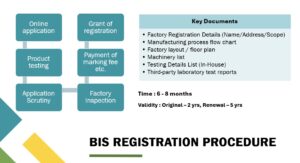
In general, one has to follow these steps:
- Pre-application Planning:
- Identify applicable Indian Standards.
- Engage a BIS-recognized test lab for product evaluation.
- Appoint an Authorized Indian Representative (AIR) if based abroad.
- Testing:
- Submit product samples at BIS-recognized labs (e.g., WFH laboratories).
- Ensure test reports are issued within 90 days.
- Online Application:
- Register on the BIS CRS portal and complete Form I.
- Upload test reports, AIR details, brand name authorization, and self-declaration forms (Forms II & III).
- Document Verification & Assessment:
- BIS verifies test results, the scope of manufacturing/import activity, and AIR credentials.
- In rare cases, plant audits may be called for, especially for high-risk categories.
- Grant of Registration:
- On approval, BIS issues a CRS registration certificate with a unique R‑number and other details like scope, validity, and Standard Mark.
- There is usually no factory audit for CRS, it’s a self-declaration-based pathway.
- Post-registration Compliance:
- Products can now carry the BIS Standard Mark + R‑number.
- BIS may undertake random sampling from the market or port.
- Non-compliance leads to legal actions such as seizure, fines, consumer complaints, and recall.
4.3. Key Requirements for CRS Registration
| Requirement | Details |
|---|---|
| BIS Recognized Lab Test Report | Product must pass safety testing as per applicable Indian Standard. |
| Manufacturing Details | The manufacturing unit must be clearly identified, whether in India or abroad. |
| Brand Authorization | If brand is separate from manufacturer, authorization is mandatory. |
| Correct Label Marking | CRS logo, model number, manufacturer name & country of origin must be correctly printed. |
Improper labeling is one of the main reasons for rejection, so compliance is essential.
4.4. Timeline for Registration
Typically:
- Testing: 7–20 working days (depending on product & test complexity)
- BIS Registration: 7–15 working days (if documents are complete)
Total Estimated Duration: 3–6 weeks
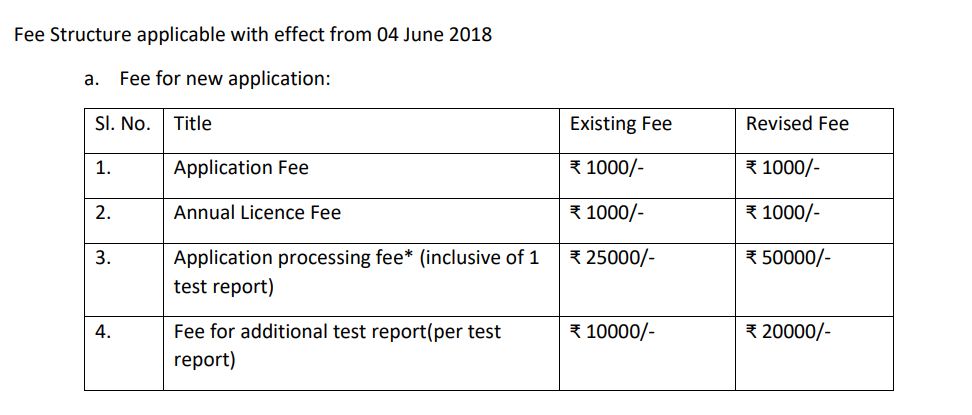
5. Cost / Fee Structure
5.1. Key Components
- BIS Government Fees: Application and registration fees vary based on categories and manufacturer location (domestic vs. foreign).
- Laboratory Testing Fees: Based on lab charges per product model.
- Consultancy & AIR Fees: If engaging third-party consultants or AIRs.
- Scale of Models: More models or brand lines typically incur higher fees.
You can check the latest fee structure for the CRS scheme on the official portal.
5.2. Approximate Total Cost
- CRS fees are often modest, especially for Indian manufacturers or small enterprises. Foreign applicants, particularly from China, may experience longer timelines and slightly higher costs.
- Examples from industry:
- CRS applications may range from ₹50,000 to ₹1,50,000 depending on models and scale.
- Testing costs per model generally range from ₹10,000 to ₹30,000, depending on complexity and test parameters.
- Consultancy can add ₹25,000 – ₹50,000 based on the products.
6. Validity and Renewal Duration
6.1 Validity Period
- CRS certificates are valid for two years from the date of issuance.
- The clock starts from the registration issue date, not the test report date.
6.2 Renewals
- Renewal can extend CRS validity by 1–5 years, subject to:
- Settlement of renewal fees, including annual marking fees and government charges.
- Submission of fresh test reports, typically valid within 90 days at the time of renewal.
- Scope verification, adding new models if needed.
6.3 Surveillance and Compliance
- Random market surveillance by BIS ensures ongoing compliance.
- Periodically, BIS may request production samples for testing or may receive consumer complaints.
- In verified cases of non-compliance, action may include revocation of registration, recall, penalties, or criminal prosecution.
7. Conclusion
BIS certification and registration frameworks—particularly ISI and CRS—are indispensable for product access to the Indian market. They ensure quality, safety, and consumer trust, while also acting as a formal compliance mechanism under Indian law. By understanding the BIS landscape—from scheme types to application processes, costs, and renewal—manufacturers and importers can chart a smoother path to market approval.
For businesses venturing into India—especially in electronics, smart devices, solar, or safes – adhering to the BIS CRS structure early not only saves time but also reduces the risk of costly market disruptions. With a clear roadmap (testing, documentation, registration, marking, surveillance), you’re well set to launch products confidently and compliantly.
Further Reading & Resources
- Official BIS Website https://www.bis.gov.in/
- CRS BIS Portal https://www.crsbis.in/BIS/forms.do
- BIS (Conformity Assessment) Regulations, 2018 https://comercinate.com/bis-crs-certification-guide/
- Quality Control Orders https://www.bis.gov.in/product-certification/products-under-compulsory-certification/
- BIS FAQ (June 2018) https://www.crsbis.in/BIS/app_srv/tdc/gl/docs/FINAL_FAQs_June_2018.pdf